If company had asked you to paint their new offices with a bunch of murals and offered to pay you a few thousand dollars or the equivalent in company shares, you would probably have gone for the cash, right? Well that’s what I thought until I found out that the company behind this was Facebook!
San Jose-based graffiti artist David Choe, was asked this very question back in 2005 by the then-President of Facebook Sean Parker. Choe painted graffiti murals for Facebook’s headquarters in Palo Alto, California and opted for payment in shares which is now worth $200 Million after the social networking giant went public on Wednesday.
Humm… maybe we could draw Mark Zuckerberg something and ask for a few shares perhaps!
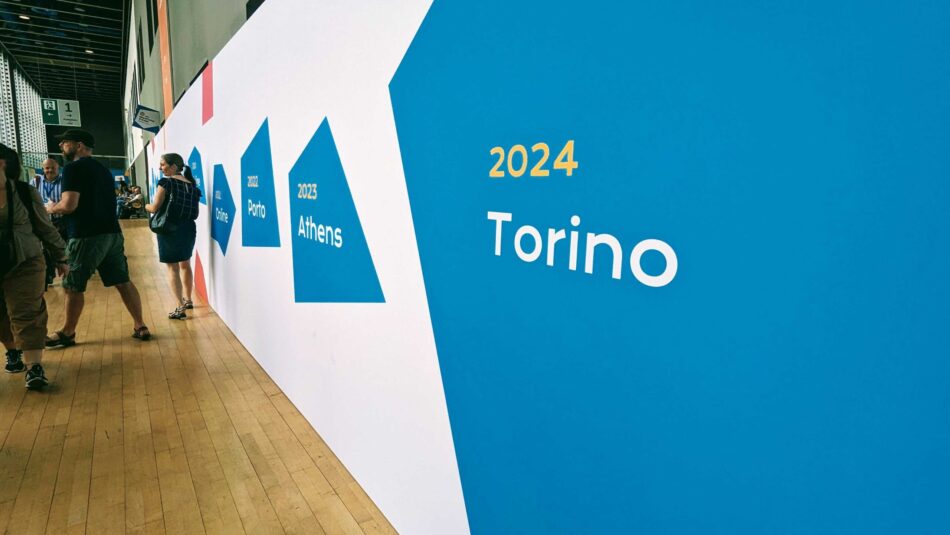
Earlier this month Phil and I headed off to Nottingham for round 2 of the New Adventures Conference. Last year was a massive success and a great way to open a new conference, which is aimed at being more affordable than most. This year Colly (now working with 2011 speaker Greg Wood on board) tried to mix things up a bit with an array of slightly lesser-known speakers.

Credit: CalEuanHopkins
All of the speakers delivered very professionally as you might expect. As is common at some conferences, the trend was for more “inspiration” based themes rather than technical learning or code examples. I think this works much better, and even though I would class myself more a developer than a designer I couldn’t help but be inspired throughout. My personal favourite talks were as follows:

Credit: Littlemad
A great way to begin the day, getting everyone up and introducing themselves to the person behind them. He went into detail about his own personal design process, plus that working for Big Spaceship on projects such as Crayola and Star Wars! But humbly saying all clients are equal and still have to overcome the same problems. His idea of “Invisible deliverables” was great – things that the client never sees but are vital to ensure the success of any project.

Credit: Littlemad
Robbie’s talk was pick of the day for me. The delivery was impeccable and perfectly paced, powerful at times! I recommend you watch the full video below. He too talked about design process and argues it’s not linear, and that the best ideas happen when we are furthest away from the tools that produce them.
“the more invisible the tools, the more creative the thinking”
He values experimentation, quick sketching, exploring ideas quickly and with freedom before evaluating them. His idea of 6-up sketching is definitely one I will be using on projects in future.

Credit: Littlemad
Trent’s obsessed with type and his talk was perhaps the most technical of the day, getting into areas such as HTML5, CSS3 and creative typography using jQuery. Right up my street! Using his Dad as an example of someone who is obsessed with their craft (in his case, Cars) he urged everyone to push the boundaries of what’s possible on the web without fear of breaking anything. How can the web evolve if no-one goes beyond? He also believes that failure is important, that mistakes are natural and perfectly fine as long as you learn from them and do things better on the next project.
For a summary of all the other amazing talks, check out: the NACONF coverage page, Speakerdeck for slides, Vimeo and Flickr.
The talks this this year were very design-focused and it seemed each speaker kept to a similar theme, whether subconsciously or as curated by Colly. I think it’s great that the industry is becoming more open about design and design process as it is something which is not often discussed. Many of the talks examined our roles as designers, even in terms of the wider world, making a difference or starting our own design-based startup. Important ideas for me were ways to become more productive and think more creatively; by disconnecting from your devices, stepping away from your tools and resting or engaging the brain in other things!
Hats off to Colly once more for another amazing day. See you in 2013!

We’ve been working a lot on building responsive sites lately. Sites which are flexible to the device they may be viewed upon, and change accordingly. For many reasons, it’s good to start small and work up to a full “desktop” version and this means it is vital we consider the site on smaller devices early in the process.
Once we had produced wireframes for a recent project, I set about producing a prototype to see how the design would work across a range of screen sizes. The desktop site follows a very conventional layout but I was keen to see how we could best optimize the header and footer for those on mobiles or tablets.
I had seen a technique used on Mark Boulton’s Five Simple Steps website to turn the primary navigation into a dropdown menu for mobiles (resize your browser to test!). Samuel Cotterall also wrote a script called touchdown.js to add this functionality.
Both these examples target a single set of links and make the navigation easier to use on a mobile device. In my example, I thought we could make better use of screen space and improve usability a bit further by grouping both sets of links together in the header (and footer). With some modification of Sam’s script I came up with the following:

View the demo or view on Github
The code that pulls this together is detailed at the above links. I also added a show/hide toggle for the Search box, a common feature on mobile websites these days where finding information quickly is paramount.
Not necessarily ground-breaking, but a neat solution which you might want to consider in your project. I can see it being extremely useful if you have a large footer with lots of columns / links you wish to group together.
If you have any questions or comments hit me up on twitter.
This Saturday, Christmas Eve, two of the major car parks in Harrogate will be offering FREE parking!
The usual income generated by the car parks will be covered by Northern Powergrid, following the untimely power-cut last Saturday afternoon that made it nigh-on impossible for retailers to trade for the majority of what is arguably the busiest day for Christmas shopping in the town. A good gesture by Northern Powergrid.
There will be approximately 1,200 free spaces in the Victoria and Jubilee multi-storey car parks throughout Saturday 24 December 2011.
As well as the major national high street retailers, Harrogate is awash with local independent shops offering unique and quality Christmas gifts. And of course there are plenty of bars, restaurants and coffee shops to keep you fed and watered throughout the day.
Just so you know, we are closed for the Christmas recess from Friday 23 December 2011 til’ Tuesday 3 January 2012. We have gifts to give, food to be eaten and beer to consume.

2011 has been a great year for Mixd and we have had the opportunity to work on some really exciting projects for some lovely clients. A big thanks to all those that have worked with us and here’s to a fantastic 2012. It’s not just clients that make us tick though. We value our relationships and interactions with suppliers, digital peers, students and anyone else who cares to engage with us!
To all of you, from the bottom of the Mixd heart, we wish you a truly fantastic festive period and all the very best for the forthcoming new year.
When Santa hit the streets of Harrogate last Christmas to collect charity donations, he took 3 ‘stooges’ with him to help conceal his true identity. But which one is the real Santa?

To enter and be in with a chance of winning a magnum of champagne, just visit the Mixd Facebook page and add your comment to the picture. Your comment should include who you think the real Santa is in the picture and your reasoning as to why. The winner will be drawn at random from all qualifying entries made on or before the 31st December 2011
Merry Christmas folks!
So it’s the end of the year and as many have been proclaiming, 2011 was the year of mobile. Well it’s certainly booming, as outlined by Bob a few months back.
Having been made temporarily flatless a week ago (long story!) and ending up sleeping on my mate’s sofa for a while, the only device I have had to complete the dreaded Christmas shop was my iPhone. Of course, during work hours it would be wrong of me to spend ages cruising Amazon (ahem!)
So how was my experience? Have to say I was pleasantly surprised.

Examples: House Of Fraser, John Lewis and Laterooms
Take a look at the three sites above; all large-scale sites I’ve visited during the festive season. They all have unique m. websites (and bloody good ones!) optimised for mobile devices.
In fact, in general nearly all of eCommerce the sites I visited had some sort of mobile site. This definitely wasn’t as common in 2010.
After a while if I visited a website which wasn’t optimised, it was an immediate turn-off. I believe that having a mobile strategy is now opt-out instead of opt-in, if you will. Consumers expect it and if you don’t provide then they will look elsewhere.
You’ve only gotta look at things like Amazon’s iPhone app and one-click ordering to see what consumers want – a streamlined experience that fits the context in which they are browsing. Testament to that is the amount of Amazon boxes that have landed in the office this week. At least 20 so-far!
There I was, traipsing around a bland town centre, with arms full of bags blowing in the wind, a light shower to add to my woes and a bag of roasted chestnuts that resembled charcoal… all whilst a Peruvian pan pipe band played ‘We Wish You a Merry Christmas’… repeatedly.
Christmas gift and food shopping all done. Purchased online. From the warmth and comfort of my own home. With a large glass of port. (It’s not necessarily all plain sailing; you must be prepared to take the odd trip to your local, friendly sorting office to exchange your ‘Sorry we missed you’ cards for parcels.)
Okay then. So other than taking the strain out of the Christmas shopping…
Surely the biggest thing must be how it has broken down barriers of geographical location, so people can communicate and see loved ones easily wherever they are on the planet?
No. Sadly not. It’s ‘The Christmas Madness Bandwagon’. Digital Christmas tat is another way of putting it. But we love it…

For more than 50 years, NORAD and its predecessor, the Continental Air Defense Command (CONAD) claim to have tracked Santa’s flights. How the heck would you do that you may ask. Well, to quote from the NORAD Tracks Santa website:
“NORAD uses four high-tech systems to track Santa – radar, satellites, Santa cams and fighter jets.”
Of course.
Now you can join the fun at the NORAD site and see Santa’s movements live at any time on Christmas Eve! As well as fascinating information about NORAD and Santa himself, seasonal digital features include ‘The Countdown Village’ for kids festive games, the official NORAD Tracks Santa App (featuring the game ‘Elf Toss’) and the ability to follow Santa on Google Earth!

As you may well have seen all over Facebook and Twitter, PNP is a hot Christmas topic this year. PNP (Portable North Pole) brings Santa to you or your loved ones via the medium of personalised video message. The blurb on the Portable North Pole site boasts:
“With just a few clicks, you help Santa gather the necessary information and he prepares a unique, tailor-made video that would delight even Scrooge himself.”
Since 2008, PNP claims to have helped Santa deliver over 20 million personalised video messages worldwide. Some stat. However, the site isn’t mobile friendly (uses Flash) so don’t try it on your iPhone. There is of course an App available though!
One more thing… I was slightly concerned about the privacy of my data. But if you say ‘Bah Humbug’ to that, get on it and enjoy!
If you’re a Twitter addict, there’s always the UK Snow Map that is powered by tweets. You can use Twitter to have the snow conditions where you are plotted on a map of the UK in real-time. To find out more, get on over to the UK Snow Map website.
The more a design team knows about the users of a site, the better they can meet their needs and design something that appeals to those users beyond the aesthetic appearance of a site. Something that looks lovely but doesn’t work for the user is pointless online. The fundamental principles of user centred design are satisfaction, efficiency and effectiveness. To reach the ‘sweet spot’, design teams need to know what the user’s needs are for each of these areas. A designer has to have knowledge to make decisions; opinions and assumptions do not count when it comes to UX and usability. Getting direct access to users gives knowledge.
User experience designers are a specific type of user centred designers. They have specialist skills in collecting and analysing user research. The techniques used during both the data gathering and analysis are essential to ensure that the results are not skewed. With quantitative research like surveys, you have to gather a large enough sample size to ensure that the responses of ‘outliers’ (fans and haters) do not skew the results. So what method do we use?
Qualitative user research is the basis of user centred design. Give design teams access to real and representative users from target audiences before the design process begins, and they are provided with the information and ideas needed to develop their thinking and avoid designing in problems that need to be fixed later. Designers themselves need to have access to the representative users to do this; a connection with real users is required to fully understand their needs. With qualitative user research, you still have to ensure that you gather the right number of participants to collect information from; however, with proper recruitment and an experienced researcher the minimum number you can use is five. Research has determined that by conducting qualitative user experience work for a site with five participants you can uncover the vast majority of usability problems.
Find out more about qualitative research.
Usability studies are focussed on existing flaws within a site. Depth interviews are concerned with preventing flaws from being built into a new site. With both, the insight gained simply can’t be obtained from surveys or quantitative data sources because they do not elicit the information we need. We cannot gather the sort of feedback we need from questionnaires or surveys simply because nobody can write down and articulate the info we gather through qualitative research… and even if we could, it would lose its potency as it’s diluted through statistical analysis.
Using a specialist researcher gives you all of their past experience. As a moderator, our user experience expert Bonny has conducted countless hours of user experience work for organisations such as eBay. By running all these sessions for clients, Bonny has gathered a lot of experience in how to deal with participants and knows how not to be distracted by irrelevant data. Furthermore, she knows how to illicit responses that tell us what we need to know… not necessarily what we want to hear! This is a skill that is often not present with novice or new researchers who can easily be lead by responses through no real fault of their own. As an example, participants will often lie unknowingly; it’s a skill to know when someone is doing this and to dig deeper without letting them know that they have lied. If you do give this away you ruin the sense of trust between the researcher and the participant.
Mental model guru Indi Young has written some interesting points on conducting better interviews over on the Adaptive Path blog.

Gordon had Ming but Adobe’s Flash has had to contend with a more powerful adversary in the Late Steve Jobs and he was equally merciless in his pursuit of wiping out his enemy.
And after years of bitter fighting it seems Jobs has succeeded where Ming failed, bringing Flash to its knees – if we are to believe the current rumours that is. Adobe is said to be pulling the plug on Flash for mobiles and tablets, instead focussing on HTML5 for playing video and animated content saying “We will no longer adapt Flash Player for mobile devices to new browser, OS version or device configurations”. Although apparently Adobe will continue to support Flash for desktop platforms as well as providing bug fixes for some mobile platforms.
Perhaps Adobe’s hand was forced though, with most mobile devices choosing the open HTML5 format instead of proprietary plugins like Flash for multimedia elements. Windows also announced recently their Windows 8 Metro browser would choose HTML5 over Flash for security, reliability and battery life. These are good choices by the device-makers, with HTML5 constantly evolving due to the efforts of the W3C Working Group hoping to bring the web towards a fully standardised, open format.
As those immortal words once pronounced – “Gordon’s Alive!” but we don’t think Princess Aura will be able to save this particular Flash…